Blog
Written in the World: Northern Symbols and Runes

Before there were books, before there were libraries, the people of the North wrote in bone, wood, stone, and hide. They carved meaning into the world — and the world, they believed, carved meaning back.
To understand Northern symbols and runes is to step into a living relationship with the landscape, the cosmos, and the invisible forces that our ancestors took utterly seriously. These were not decorations. They were technology — spiritual, practical, and profoundly human.
What Are Runes?
The word “rune” comes from the Proto-Germanic *rūnō, meaning secret, mystery, or whispered counsel. In Old Norse, rún carried the same weight: something hidden, something known only to those who had learned to listen. This is not a coincidence of etymology. It is a clue.
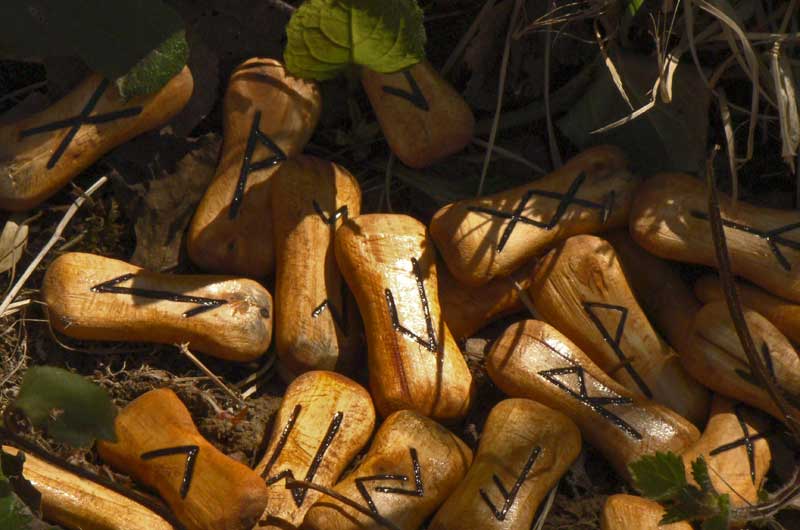
Runes were the writing system used by Germanic peoples across Northern Europe from roughly the 2nd century CE onwards, though their roots stretch back further into older symbolic traditions. The earliest widely recognised runic alphabet is the Elder Futhark — named after its first six characters: F, U, Þ, A, R, K. It consists of 24 runes, each one a letter, a sound, and a concept simultaneously.
Over centuries, the system evolved. The Younger Futhark (used in the Viking Age from around 800 CE) condensed the alphabet to 16 runes. Anglo-Saxon runes expanded it. Medieval rune-rows flourished in Scandinavia long after Christianity arrived, demonstrating how deeply these symbols were woven into everyday life. In Finland, a related tradition of sacred marks and symbols developed in parallel — connected to, but distinct from, the Norse runic system.
The Origins: A Gift From the World Tree
Norse mythology offers a striking origin story for the runes. According to the Havamál — the Words of the High One, one of the poems of the Poetic Edda — the god Odin did not merely discover runes. He earned them through ordeal:
“I hung on that windy tree / nine full nights, / wounded with a spear, / given to Odin, / myself to myself / on that tree / which no man knows / from what roots it rises.”
— Havamál, stanzas 138–139 (translation in the public domain)
Odin hangs for nine nights on Yggdrasil, the World Tree, without food or water. Near death, he peers into the abyss beneath the tree — and the runes reveal themselves. He screams, seizes them, and is reborn into knowledge.
This is not simply a myth about writing. It is a mythological map of shamanic initiation: the deliberate encounter with suffering, death, and transformation as the price of deep knowing. The World Tree is the axis of all existence; to hang upon it is to perceive all worlds simultaneously. Odin is the original rune-seeker — the shaman who sacrificed comfort for wisdom.
How Runes Were Used
It would be a mistake to think of runes purely as letters. Yes, they were used to write inscriptions on memorial stones, grave markers, weapons, tools, jewellery, and wooden staves. But their function was never merely linguistic.
Runes served as:
Protective charms. The Algiz rune (ᛃ), shaped like a raised open hand or elk antler, was carved onto weapons and armour for protection in battle. The Tiwaz rune (ᛆ), associated with the god Tyr, was inscribed on sword blades to invoke victory.
Healing tools. Certain runes were carved or painted onto wooden staves and placed near the sick. The healer would “read” the runes not in a literary sense but in an energetic one — interpreting their power in relation to the patient’s condition.
Tools for divination. Tacitus, the Roman historian, describes Germanic tribes in the 1st century CE casting lots carved on pieces of wood from a fruit-bearing tree. These lots were almost certainly runic. The caster would ask a question, close their eyes, and draw three marks — reading the pattern as an answer from fate.
Magical workings. The Norse called runic magic galdrar — chanted, sung, or whispered spells. Combining runes into bind runes (merged symbols) created concentrated power. A bind rune might be inscribed on a ring to attract love, on a ship’s prow to ensure safe passage, or on a threshold to ward the home.
Markers of commemoration. The great runestones of Scandinavia — Sweden alone has some 2,500 of them — were raised to honour the dead, record journeys, and assert ownership. They are the monumental expression of runic culture, many still standing in fields and forests today.
Northern Symbols Beyond Runes
The runic tradition was one part of a far broader world of sacred symbols across the North. Across Scandinavia, Finland, and Siberia, shamanic cultures developed their own visual languages for navigating the seen and unseen worlds.
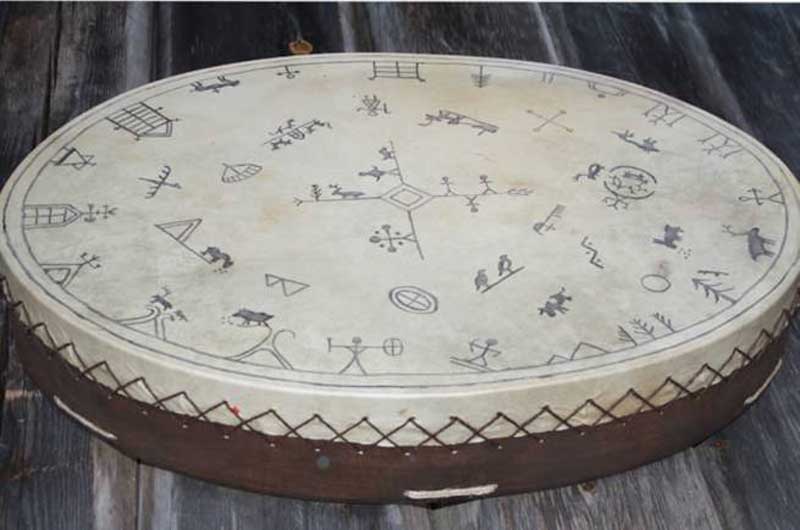
Among the Sami people, the most powerful of these visual languages was found on the shamanic drum — the runebomme or nàideattambour. The drum’s surface was painted with a cosmological map: the three worlds of existence, the sun and moon, animals of power, ancestor spirits, and the pathways between realms. When the shaman entered trance through drumming, these symbols served as navigational guides, anchoring the spirit journey within a known cosmology.
Other prominent Northern symbols include:
The Valknut. Three interlocking triangles, associated with Odin and the fallen warrior. It appears in Norse carvings near burial sites and is thought to represent the nine worlds of the Norse cosmos, or the cyclical nature of death and rebirth.
The Vegvísir. Known as the “Wayfinder” or Norse compass, this eight-pointed symbol was said to guide the bearer through storms and difficult passages — not just physical ones, but the storms of the spirit. It appears in the Icelandic Galdrabók, a 17th-century grimoire.
The Ægishjalmur. The Helm of Awe: an eight-armed symbol radiating from a central point, used to induce fear in enemies and protect the wearer. It appears in the Poetic Edda as a charm used by the dragon Fafnir.
Triquetra and triple spirals. Found across Celtic and Norse cultures, these forms represent the tripartite nature of time (past, present, future), the three realms of existence, or the phases of the moon. They speak a language of cycles — the same language written in the seasons themselves.
Why Did People Use Them? Meaning in a World Before Modernity
To ask why Northern peoples used runes and symbols is, in some ways, to ask why we use language at all: to make meaning, to act upon the world, to connect with one another and with forces greater than ourselves.
But there is something more specific at work in the Northern tradition. These cultures lived in intimate relationship with an often-harsh natural world. Winter was long. The dark was deep. The sea was dangerous. Disease was unpredictable. In this context, symbols were not superstition — they were a form of agency. To carve a protective rune was to do something real about a real threat. It was the equivalent of taking action, of refusing helplessness.
Symbols also served as memory technology. In oral cultures, visual marks anchored stories, cosmologies, and genealogies in the world — on standing stones, carved beams, and the faces of drums. They made the invisible visible, and the ephemeral permanent.
And perhaps most profoundly: they connected the individual to something vast. A single person carving the Sowilo rune (the sun rune, ᛉ) onto a piece of wood was connecting themselves to the sun, to its warmth and power, to the cosmic cycles of which their small life was a part. Symbols were bridges — between the human and the divine, the known and the mysterious, the personal and the universal.
What We Can Learn From Them Today
We live in a time saturated with images and signs, yet many people report feeling profoundly disconnected from meaning. The Northern tradition of symbols offers something quietly radical in response to this: the idea that meaning is not found, but made. It is crafted, carved, and carried.
Working with runes and Northern symbols today does not require adopting ancient beliefs wholesale. What it offers is a practice of attention: the deliberate act of sitting with a symbol, turning it in the mind, and asking what it stirs in you. Each rune carries a world of association — Fehu (cattle, wealth, abundance), Isa (ice, stillness, suspension), Berkano (birch, growth, new beginnings). Meditating on a rune for a day is a remarkable exercise in focused awareness.
The tradition also reminds us of the power of physical, handmade objects. A rune carved by your own hand into wood or stone is not the same as one printed on a T-shirt. The act of making is itself significant — it requires slowness, presence, and intentionality. In a world of mass production and instant consumption, this is quietly revolutionary.
Finally, the Northern symbolic tradition teaches us something essential about the nature of wisdom: that it must be earned. Odin did not receive the runes as a gift. He surrendered himself to the unknown. The symbols that carry the most meaning in our lives are rarely the ones we stumble upon. They are the ones we have sat with long enough, suffered for enough, to truly understand.
Related Posts
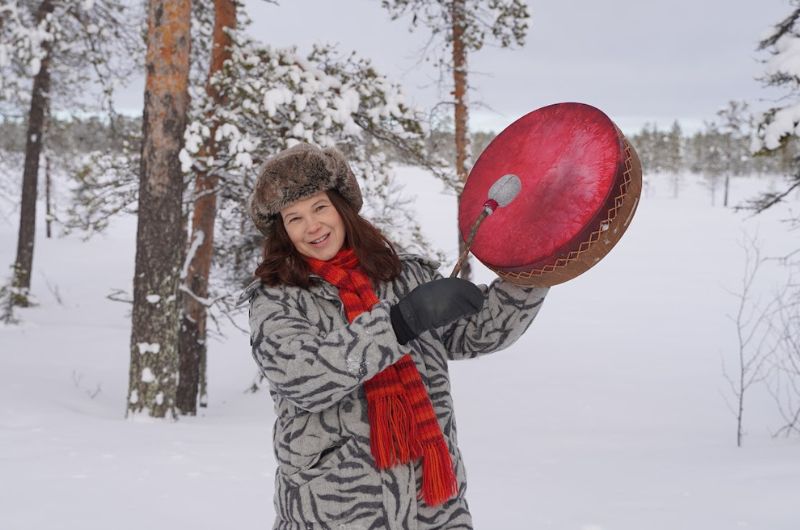
Finding Love in Unexpected Places: Your Drum as a Companion

With Valentine’s Day approaching, I’ve been reflecting on friendship, connection, and the many forms love takes in our lives. Here in Finland, we actually celebrate this day a bit differently – we call it Ystävänpäivä, Friend’s Day. Rather than focusing solely on romantic love, we honour all the meaningful connections in our lives: friends, family, and yes, even the relationship we have with ourselves.
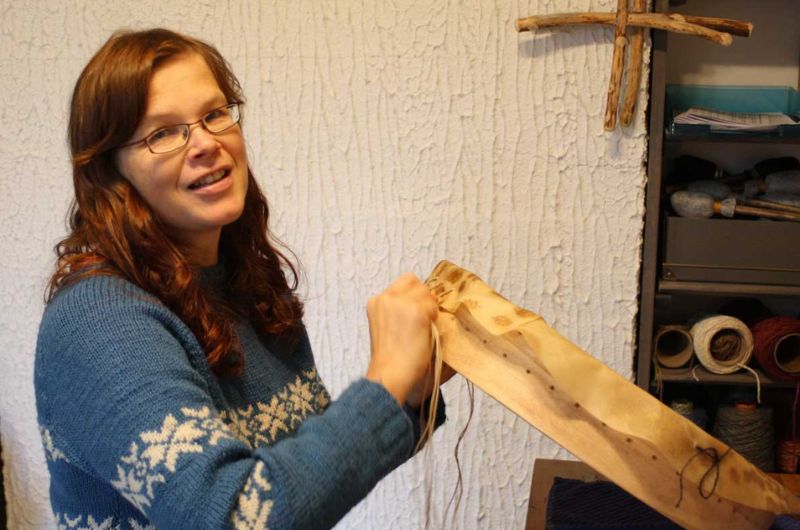
How Working with Your Hands Brings Deep Wellbeing
Have you ever lost yourself so completely in a task that hours felt like minutes? Where the outside world faded away, and there was only you, your hands, and something beautiful taking shape before your eyes? Here at Rumpu-ukko, we experience this magic almost daily. When I’m crafting a new shamanic drum – stretching the reindeer hide, adjusting the tension just so, listening to the first tentative beats – time simply disappears. My mind quiets. My breath slows. The constant mental chatter that usually fills my head fades into silence. It’s not work in the traditional sense. It’s flow. It’s meditation. It’s joy.
And as it turns out, science is now confirming what craftspeople, artisans, and makers have known in their bones for millennia: working with your hands is extraordinarily good for you – not just physically, but mentally, emotionally, and even spiritually.

Forest Bathing with Your Shamanic Drum
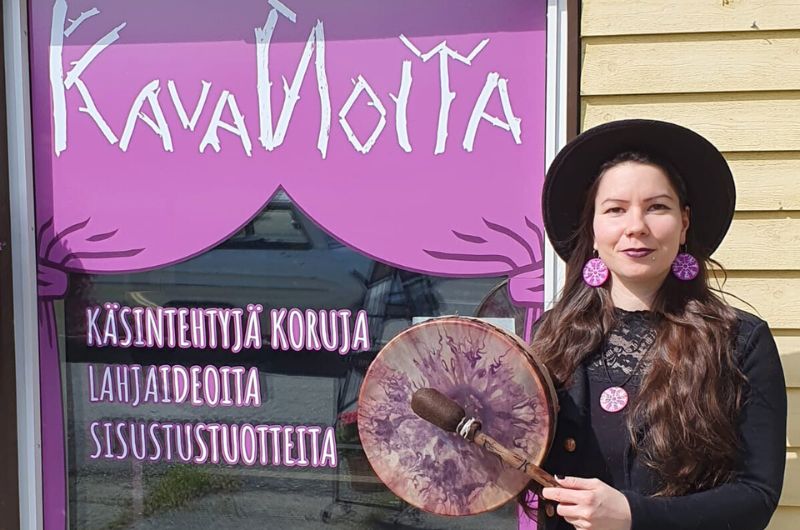
Rumpu-ukko Partners with KavaNoita in Sodankylä
Sometimes the universe has a wonderful way of bringing kindred spirits together. That’s exactly what happened when we discovered Marjo Kavakka’s KavaNoita boutique in Sodankylä.
Planning a trip to Lapland? Now there’s an enchanting new reason to stop by Sodankylä. At KavaNoita boutique, you can experience the perfect blend of our shamanic drums and Marjo’s mystical jewellery – two crafts that share the same spiritual depth and connection to ancient wisdom.
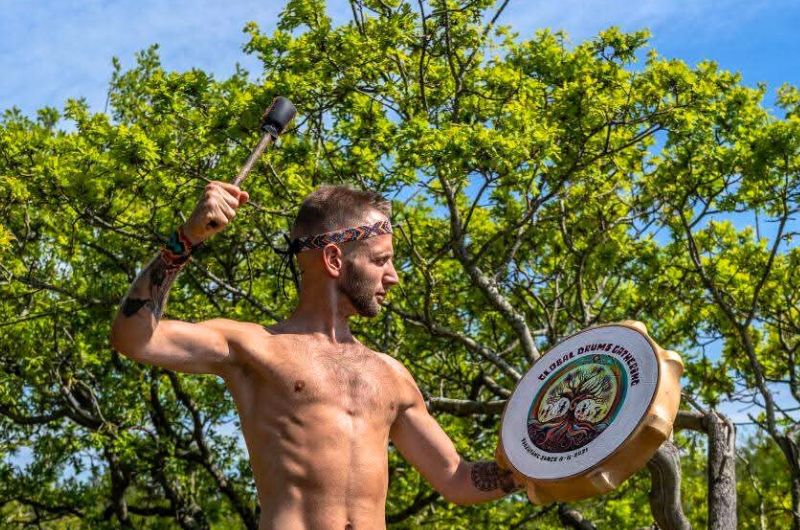
Heart Warriors Unite: Join the Global Drumming Revolution This Lion’s Gate Portal
When the thunder of drums ripples across our planet on the Lion’s Gate Portal, something extraordinary happens. The Global Drums Gathering returns on Friday evening 8.8.2025 at 8 PM. This sacred moment begins in New Zealand, and a wave-like energy starts racing clockwise around our beautiful planet. From his shamanic community base in the Netherlands, Dennis Vessies is organising this magical event for the fourth time – and you’re invited to be part of this worldwide tribe!
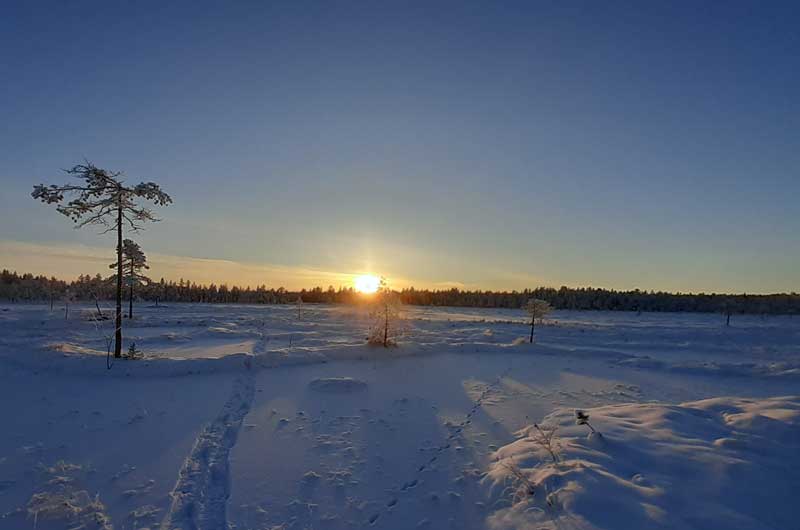
It Is Talking to Me…A Winter Journey with Shamanic Drums
The snowshoes crunch on the frost-covered snow. The old path through the forest has nearly vanished after last night’s snowstorm, and I can only see occasional depressions in the snow to guide my way. There’s no danger of getting lost, however; I’ve traversed this forest strip so many times that I could almost navigate it blindfolded. The snow is already over half a metre deep, so I take care not to slip off the path, which happens if one steps from the compacted base into the soft snow.

Which Shamanic Drum Should I Choose?
As craftspeople dedicated to traditional Finnish drum-making, we often hear this question from prospective buyers. Whilst there’s no one-size-fits-all answer—as each person has their own style, colour preferences, and reasons for wanting to drum—we can guide you through the unique characteristics of our different drums to help you make an informed choice.
Nordic Shamanism: Arctic Wisdom in a Changing World
In the far reaches of the Nordic countries, where the aurora borealis paints the sky and the midnight sun defies the night, lies the homeland of the Sami people. Their rich spiritual traditions, deeply rooted in the Arctic landscape, offer profound insights that resonate even in our modern world.